
微博
Short drama productions, AI are bringing new life to rural Chinese villages_我的网站

一 | 2008年1月15日——1月14日,中国第一条5G环路在成都二环高架桥上空转,市民可以在公交车上体验2.4GH/s的下载速度。
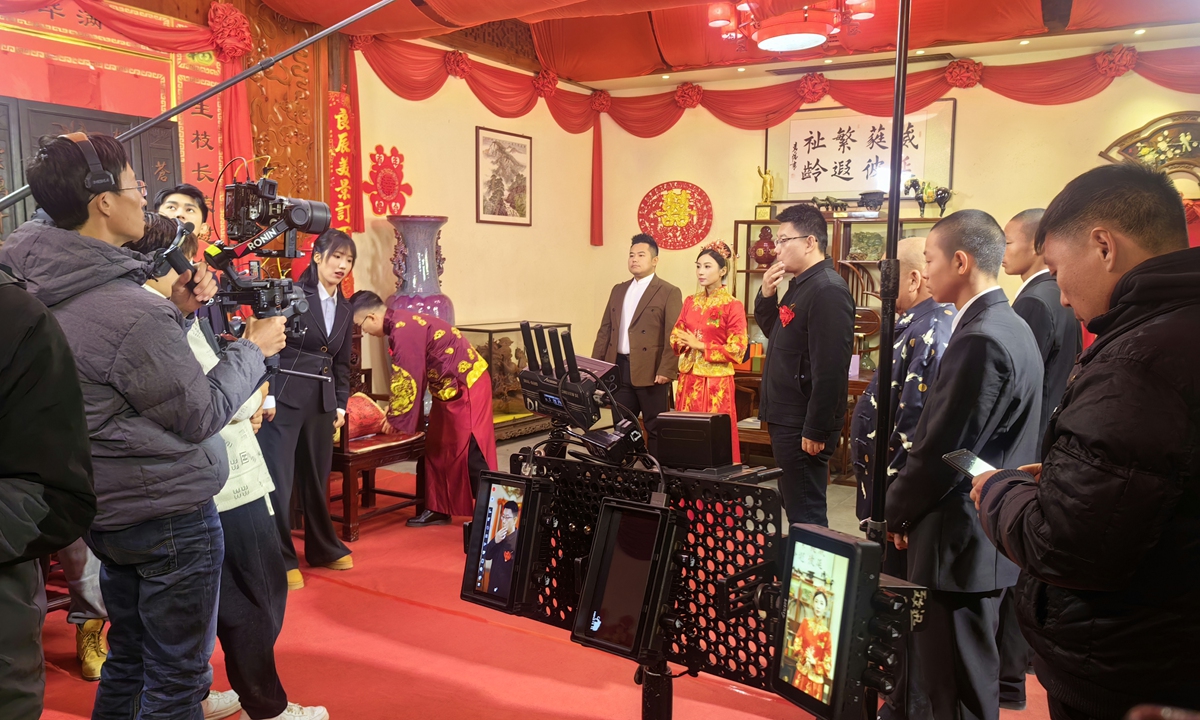
Yang Ni, a villager from Yuanqiao in Dengfeng, Central China's Henan Province, still remembers the nervous excitement of facing a slowly advancing camera for the first time. Now, she shifts with ease between roles, from a maidservant trailing a heroine in a historical drama to a famine-struck villager before the People's Republic of China was set up in 1949.
Experiencing so many lives within various screenplays, Yang said that short dramas have transformed not only her life, but also the ancient village she calls home.
Yuanqiao, a small village with a history that traces back over 600 years, has welcomed more than 70 short drama crews in recent years. The creators have captured every angle of the village's traditional courtyards, winding alleys, and gently rising cooking smoke. Locals have grown used to exchanging their daily farm clothes for costumes between busy seasons, giving life to lively townsfolk on vertical screens.
Yuanqiao village's revitalization is not just a story told through the camera lens. Si Jianbin, responsible for short drama coordination in the village, told the Global Times that the changes brought by short drama filming are visible in many ways.
With traditional buildings serving as natural film sets, once-abandoned houses, crumbling village walls, and old opera stages have been repaired and preserved. This has renewed villagers' sense of cultural stewardship. The arrival of drama crews has also broadened job opportunities for local youth; more young people are now choosing to stay or return home, breathing new life into the village.
Si noted that challenges also persist. The swift rise of AI-generated dramas is reducing demand for real-life shoots, and the number of visiting productions in the village has started to drop. Still, Si remains confident, noting that the village's authentic architecture meets the growing demand for high-quality short dramas. He said that leveraging this unique match will secure a promising future for revitalizing rural areas through film.
Changed villages
"For years, I only saw our old houses as broken-down obstacles; after filming, I realized every brick and tile is our cultural heritage," Yang said. Having played a background actor in numerous dramas - from period pieces to modern stories - she and her neighbors now see their ancient city walls, opera stages, temples, and homes through new eyes.
Some once-vacant houses have found new purpose as meticulously arranged sets, bearing witness to love stories or family feasts. One courtyard, frequently appearing in short dramas, is adorned with red lanterns and paper cuttings to express joy. Villagers redecorate it for shoots, blending cheerful ambiance with authentic period feel.
Today, Yuanqiao's residents - all from toddlers to seniors, even family donkeys and dogs - have become "stars" on camera. People farm during the busy season, then slip into costumes to perform, seamlessly shifting between fields and film sets.
Younger villagers have found new skills and work too. Si noted that more than half of local youth have acted as extras, with some job-seeking college graduates now learning editing and computer skills from the drama teams, opening the door to steady work in short film production.
The economic benefits for the village are clear. Si pointed out that village income grew from 4 million yuan ($593,330) in 2024 to over 5 million in 2025, a 20 percent of increase thanks to short drama filming. Most villagers have seen their annual incomes rise by around 5,000 yuan as a result.
Traditional crafts once on the verge of disappearing - such as paper-cutting and basket-weaving - are also reviving. Villager An Qing'e, known for her hand-woven flower baskets, was discovered by a filming crew and soon found online customers for her props.
Tourists, too, are seeing the village in a new light, as site visiting becomes an immersive experience. They are no longer fleeting passersby, but participants in the living stories of the ancient village.
The sets created for filming repurpose historical spaces, allowing visitors to step into the joys and sorrows of different eras.
This phenomenon is not limited to Yuanqiao village. The unique needs of rural and historical short dramas perfectly match the spaces and cultural resources of China's villages. Other places, such as Hujiaxi in Yuanling county, Central China's Hunan Province, and Nanhu in Jinyun county, East China's Zhejiang Province, are attracting drama crews and experimenting with a rural revitalization approach combining short drama with agricultural and cultural tourism.
Seeking the irreplaceable
Still, the path for rural short dramas is being tested by the realities of the market.
The rise of AI-generated content is quickly diverting orders away from real-location shoots. Si said that after peaking at 35 crews in 2025, the number shrank to one or two per month in Yuanqiao village by 2026.
Even so, Si sees a hopeful future. While AI short dramas win on low-cost virtual settings, China continues to encourage the creation of well-crafted real-life dramas through supportive policies.
There is a lasting appeal in the atmosphere, sense of history, and human vitality that only real villages can provide - qualities virtual images cannot match. As audiences and studios increasingly seek authenticity and quality sets, villages like Yuanqiao have lasting room to grow.
Zhang Peng, a cultural researcher and associate professor at Nanjing Normal University, told the Global Times that the rise of AI-generated short dramas is reshaping the industry. However, this does not mean villages will lose out on the benefits brought by filming. On the contrary, when the bubble fades, truly valuable villages may be in even greater demand.
Their core competitiveness is not just cheaper venues, Zhang explained, but their unique local culture, authentic lifestyle, and the fusion of online and offline tourism experiences.
"To keep these benefits, villages should not compete with AI on cost and efficiency," Zhang noted. "Instead, they must redefine their own irreplaceability in the production chain."
Ding Daoshi, a veteran internet analyst, offers a word of caution: short dramas change fast, and their impact rarely lasts as long as movies or TV series. For villages, the key to sustainable development is leaning on their unique heritage and not just short dramas.
By finding their own irreplaceable assets and combining them with the energy of film, they can secure their future for the long haul.
。据报道,可以同时下载20个100兆光纤,速度是4G网络的66倍。

二 | 视频截图显示,环形总线有一个很大的5G网络标志。2018年12月5日,成都市首条5G环线正式开通,国内首条5G客车投入试运行。率先在全国实现5G商业审判。在每小时40公里的公交车上,5G网络的实时峰值速度达到2375 Mbps,这意味着蓝光胶片可以在几秒钟内下载。
Current article:http://dimyl.ruwentaqintiaozhupapaigai.shop/news/20260826_9848352.html
Published on:05:43:34
 长城
长城 春妮的周末时光